
The armed forces of India will be wise to remember that its public interface needs to be tempered with discretion, maturity and example, keeping in mind the nation's multi-cultural and multi-religious fabric which is its greatest strength but which can also become its biggest fault-line, asserts Vice Admiral Biswajit Dasgupta (retd).

'Once the actual scope is understood, it becomes evident that the framework is about internal redress and course correction, and in no way criminalisation.'

The rupee recovered 55 paise from its all-time low level to close at 90.38 against the US dollar after a volatile trade on Wednesday, amid suspected aggressive central bank intervention.

Only 17 per cent of boards play an active role in shaping company strategy, said a survey by the Indian School of Business (ISB). According to the survey, 83 per cent of the boards remain passive, playing no active role in the company's management.

Real GDP growth surprised on the upside in 2025, but weaker nominal growth, trade uncertainty, and soft demand signal a bumpier road ahead.
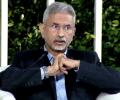
On President Putin's two-day trip to India, Jaishankar said for a "big" and "rising" country like India, it is important to maintain good cooperation with as many important players as possible in the world in line with freedom of choice.

Usually, in the western view, corporate success is attributed to efficiency, organisational structure, and scale. R Gopalakrishnan and Harish Bhat argue that philosophy, culture, and the transmission of values are more important for sustaining growth and profitability of an enterprise over a period of time.

'Many senior Bangladeshis feel Bangladesh will fall into anarchy if the Jamaat becomes an important part of a future government or has disproportionate influence in the government.'
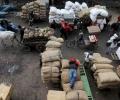
Notwithstanding global headwinds, the Indian economy saw further momentum in October on the back of goods and services tax (GST) rate rationalisation and festival spending, as indicated by high-frequency indicators, the Reserve Bank of India's (RBI's) monthly State of the Economy report said.

India's real gross domestic product (GDP) is likely to grow at 7.5 per cent in FY26 and moderate to 7 per cent in the subsequent fiscal year, a domestic rating agency said on Wednesday.

The Indian economy is growing at a robust pace, driven by strong domestic demand, low inflation, and the healthy balance sheets of banks, said a Reserve Bank report released on Wednesday.

The latest move removes one of the key friction points for visitors, temporary liquor permits, while allowing licensed hotels and restaurants operational flexibility.
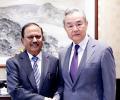
Wang is travelling to India days ahead of Prime Minister Narendra Modi's planned trip to the Chinese city of Tianjin to attend the annual summit of the Shanghai Cooperation Organisation.
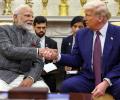
The new US national security strategy signals a retreat from global dominance while reaffirming continuity in India's role in Indo-Pacific security and Quad cooperation, points out former foreign secretary Shyam Saran.
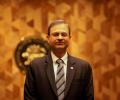
The consumer price index (CPI)-based inflation hitting an all-time low in October would encourage the six-member monetary policy committee (MPC) of the Reserve Bank of India (RBI) to cut the policy repo rate in its upcoming December 3-5 meeting. However, the July-September GDP growth, expected to be above 7 per cent, may act as a deterrent.

'Rate cut looks unlikely and there is reason to believe that the cycle is over.'
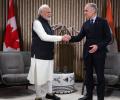
For Canada, important steps towards containing domestic elements that fuel pro-Khalistan sentiments can go a long way in signalling trust positively with regard to security and sovereignty, point out Harsh V Pant and Vivek Mishra.

Maruti, IndusInd Bank, Bajaj Finserv, Eternal, Mahindra & Mahindra, Tata Steel, Kotak Mahindra Bank, Titan, HDFC Bank, and NTPC were among the other major gainers. Bharti Airtel and Sun Pharma were the laggards.

'Solutions developed in India are being commercialised and offered globally because we're executing at scale, creating new markets and revenue streams.'

Putin's State visit will centre on fixing the huge India-Russia trade imbalance, with both sides pushing to lower duties, ease non-tariff barriers, and seal a landmark mobility pact to send more Indian workers to Russia.
'The real story of 2025 is that India officially stopped being a 'market of the future' and started acting as the world's primary economic engine.'

'Only four or five original companies remain; the rest have been replaced every decade as sectors evolve or leadership shifts.' 'Companies that fail to adapt -- like many textile mills from the 1970s and shipping firms from the 1980s -- disappear.' 'Benchmark indices reward those who reinvent themselves in line with economic demands.'
'In the long run, India's strong growth story and reforms to make assets globally attractive will determine the rupee's resilience.'

'What we are willing to do is definitely going to depend on what the Indian government wants to do.'
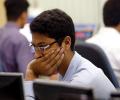
Initially, the lure of a big paycheck may feel rewarding. But, over time, professionals find themselves drifting away from family, friends and personal joys, observes Pradeep Pramanik.

India's new climate pledge to the UN could be weakened by its growing use of coal, even as the country plans a 2035 roadmap to cut emissions and boost clean energy.

Overall hiring volumes grew by 17 per cent year-on-year across key consumption-linked sectors during the August-October period, driven by heightened consumer sentiment, attractive festive promotions, and wider geographic penetration, according to a report.

State Bank of India, Tech Mahindra, Larsen & Toubro, Tata Steel, Sun Pharma, Infosys, HCL Tech, Axis Bank, Tata Consultancy Services and NTPC were among the biggest laggards among Sensex shares. Nestle, Hindustan Unilever, Titan, Power Grid, UltraTech Cement and ITC were among the gainers.

India has expressed its expectations for Saudi Arabia to consider 'mutual interests and sensitivities' in their bilateral strategic partnership, following Riyadh's strategic defence pact with Pakistan.

Noting that recent uncertainties created by global tariffs have not impacted the Indian economy severely, Anuradha Thakur, secretary, Department of Economic Affairs, said the central government is hopeful that the recent goods and services tax (GST) rationalisation will ignite the much needed animal spirits in the financial sector.

Equity markets this week would keenly track the upcoming GST Council meeting, macroeconomic data announcements and trading activity of foreign investors for further movement, analysts said. Moreover, developments related to tariff negotiations, global market trends and auto sales data would also drive investors' sentiment.
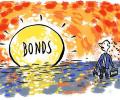
India's corporate bond market, driven by public sector undertaking (PSU) banks and financial institutions last year, is losing momentum since the second quarter of FY26.

Pakistan announced a 48-hour ceasefire with Afghanistan following deadly border clashes. The agreement aims to facilitate dialogue and find a resolution to the conflict.
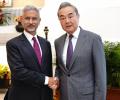
China promised to address three key concerns of India, the sources said.

A software engineer who was suddenly laid off after 15 years shares the lessons he learnt about how to cope in these uncertain, insecure times.

'Even if tariffs are reduced, non-tariff may still remain a challenge.'

We propose an expert group be set up to form a national strategy on digital fraud. This group would bring together skills in financial regulation, security economics, cyber defence, and public communications, and an understanding of the Indian financial and security systems. It should lay the foundations of a coordinated approach by the Indian State in fighting digital fraud, suggest Ajay Shah and Nandkumar Saravade.

United States Secretary of State Marco Rubio on Thursday (local time) hailed India as 'one of the top relationships that the US has in the world today' during the Senate confirmation hearing for Sergio Gor, US President Donald Trump's nominee for US Ambassador to India.

Experts believe it would be far-fetched to believe that Riyadh would support Pakistan militarily in any conflict with India, which has robust strategic and economic relations with Saudi Arabia.

The investigation for 7/11 blast in which 189 people died was under question mark from the very first month after the Mumbai Anti-Terrorism Squad started arresting the accused from different parts of city. Within 10 days of blast by July 22, 2006, ATS arrested all the 13 terror accused in the case under the leadership of ATS chief, K P Raghuvanshi.
